Search “AI certification” and you get a wall of them. Most come from companies you have never heard of, sold on the strength of a badge for your LinkedIn, with no way to tell from the outside whether passing one means anything. The rigor is anybody’s guess. A hiring manager who sees one on a resume has the same problem: it could stand for a hundred hours of real work or an afternoon of clicking through slides.
The Claude Certified Architect exam is the one I decided was worth my time. It comes from Anthropic, the company that makes Claude, so a colleague or a manager has probably heard of it, and the bar is set by people who actually know the material. I sat it in June and passed with a modest 865 out of 1,000. This is what it is, what it tests, what I learned, and how I got there.

What the exam is
The Foundations exam is sixty scenario-based multiple-choice questions in two hours. You need a scaled score of 720 out of 1,000 to pass, which does not mean answering 72% of the questions correctly; harder questions carry more weight. It costs $125 to sit, it is proctored, and as of the end of June it runs through Pearson VUE like most professional exams. The credential is good for twelve months. Renew on time and it is a short, free, unproctored check. Let it lapse and you sit the whole proctored exam again at full price.
The retake rules are humane, which I appreciated going in. Fail, and you wait fourteen days before your second attempt, thirty days before your third, and ninety before your fourth, capped at four attempts in any twelve-month stretch. An earlier version of the exam made you wait six months after a failure. That rule is gone, so don’t let an old blog post scare you off.
The five domains
The exam splits into five domains, and their weights tell you what it cares about. Agentic architecture is the largest at 27%: how to design an AI that plans, calls tools, hands work to sub-agents, and does all of that reliably. Claude Code configuration is 20%: setting up the terminal coding agent, its instruction files, permissions, and custom commands. Prompt engineering is another 20%: writing instructions that produce good, consistent results, and defending against prompt injection. Tool design and MCP is 18%: connecting a model to outside tools and data safely through the Model Context Protocol. Context management rounds it out at 15%: deciding what the model should see at once, what to cache, and how to work around its blind spots in long inputs.
Two of those, prompt engineering and context management, are things anyone using any AI runs into, whether that is Claude, Copilot, or Gemini in a chat window. The other three lean toward building. Agent architecture, tool connections, and Claude Code configuration assume you are assembling systems on top of an API, doing more than talking to an assistant. So be honest with yourself about the fit. If you build with AI, or want to, the exam maps cleanly onto that work. If your day is mostly asking Copilot to tidy up emails, a good third of the exam will describe a job you do not have yet. I found that stretch worthwhile. Someone hunting for a quick credential in their current lane might not.
The humbling
I went in about as close to a home-field favorite as you can be, or so I thought. I use Claude Code heavily in my own time. I took Anthropic’s free preparation courses and scored 100% on the in-course practice questions, first try, every module. I felt ready.
Then I took the first full-length practice exam and scored 709. The pass mark, again, is 720. I had missed by a rounding error, right after acing every quiz the courses put in front of me. The lesson landed hard: the courses had taught me the courses. The exam was testing something wider, and a perfect score on the friendly questions had told me nothing about the gap between what I knew and what I would actually be asked.
How I closed the gap
What moved my score was making the AI grade me. After the practice exam I put two documents in front of the model: the official exam guide, and the full text of my practice-exam review, meaning every question, my answer, the correct answer, and the scoring. Then I asked it to do the work a good tutor would:
Attached are (1) the official exam guide and (2) the full text of
my practice exam review: questions, answers, and scoring.

Identify which of the scenarios outlined in the exam guide I was
tested on. Analyze my answers to find weak spots and areas to
improve.

For each domain in the exam guide, give me a readiness score. I am
aiming to pass with a score above 900 out of 1,000.

Return a report with rules to remember and explanations for every
problem I got wrong, then build a cram guide from it.
What came back was a readiness score for each of the five domains, an explanation for every question I had missed, and a study guide built from my own wrong answers. That is the part that mattered. I stopped studying the whole syllabus and started studying the specific things I did not know.
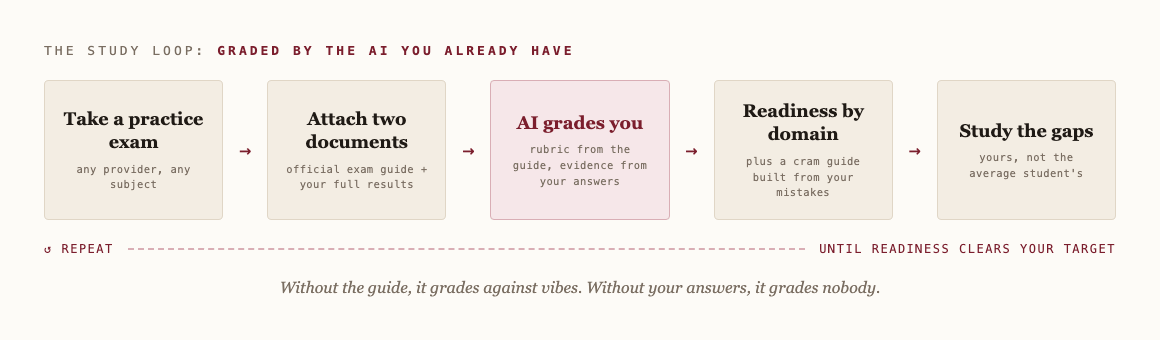
The loop I ran until my readiness scores cleared the pass mark: grade the practice exam against the official guide, study only the gaps, repeat.
What I actually learned
The passing score taught me nothing. My weak spots taught me plenty, because they were specific, and each one has stayed with me at work.
The first was knowing when to refine a prompt versus when to reach for a harder guardrail. A lot of working with AI comes down to deciding whether a bad result means you asked poorly or means you need to constrain the model so it cannot wander off in the first place. I had been treating every bad output as a prompting problem and reflexively rewording. The exam kept pushing on cases where the right move was a rule rather than a better sentence, and I got several of those wrong before it clicked. I reach for the guardrail sooner now.
The second came straight from my background. I come to this from tax rather than software, and the parts of the exam about team software practices were genuinely new to me. Permissioning, and the careful handling of things like access tokens for a connected tool, are second nature to an engineer and were not to me. On personal projects it never mattered whether I did any of that correctly. The exam made clear it matters a great deal the moment other people, or real client data, are involved. I would rather have learned that from a practice question than from a mistake at work.
Is it worth it
A few honest notes for anyone weighing it. The free courses are worth taking and nowhere near enough on their own; they gave me confident answers to maybe a third of the exam. You will not be asked to write code. The questions probe whether you understand the concepts and the tradeoffs behind the tools, which is a fairer test of whether you can actually use them.
Would I recommend it? Yes, and more than I expected to going in. A badge on its own changes nothing. What preparing for it did was force me to find the holes in how I work with AI, and it happens to be one of the very few credentials in this space that a colleague will actually recognize.
The courses, the official exam guide, and the handful of other things that genuinely helped me prepare are on the resources page of the site (samuelmchargue.com/resources). All of it free, which is the only kind of recommendation this newsletter makes.
If AI is becoming part of how you work, this is the exam I would spend the time on. The certificate matters less than what studying for it does to you.
Samuel L. McHargue